


- Home
- Teaching & Learning
- Our Curriculum
Our Curriculum
Mission Statement
The Haggerston Way: Our Mission Statement is expressed through three key value statements that shape everything we do at Haggerston School.
- Aspiration: We strive to be the best version of ourselves: Aspiration means working with purpose. It’s not just wanting success — it’s earning it through effort, focus, and resilience. We teach students that aspirations are goals with a plan, built on knowledge, attendance, and hard work. At Haggerston, aspiration is effort with direction.
- Creativity: We create beautiful work to inspire others: Beautiful work is thoughtful, precise, and knowledge-rich — whether it’s writing, design, or problem-solving. Creativity and knowledge go hand in hand: curiosity and imagination are nurtured through growing understanding, skill, and discipline. At Haggerston, creativity is rigour in action.
- Character: We are articulate, confident and determined individuals: Character is not inherited — it’s built. Through daily habits and modelling, we teach resilience, respect, and integrity. With strong character, our students lead with confidence, face challenges, and contribute positively to their communities. At Haggerston, character is taught, not assumed.
Curriculum Rationale
Our curriculum aims to deliver the following outcomes:
- Exceptional academic outcomes at GCSE and A Level, relative to each student’s starting point in year 7.
- Broad, balanced, and enriching learning experiences that build curiosity, creativity, and a lifelong love of learning.
- Strong moral and social development, preparing students to play a positive role in modern Britain.
- Equitable opportunities and personalised support for every learner to access, engage with, and succeed in the curriculum.
- Positive post-16 and post-18 destinations that reflect each student’s aspirations and talents.
We provide a high-quality curriculum and ensure they capture the following principles:
- The curriculum is content-rich/knowledge-rich. The learning objectives are specific, cumulative, well rounded, preparatory and rigorous
- The curriculum is standards-aligned. It is suitable for learners at different stages of their learning journey
- The curriculum supports effective, research-based pedagogy such as formative assessment, feedback, and metacognition
For more information about our curriculum, please complete the enquiry form on the Contact Us page.
Points 2.1 to 2.4 below demonstrate how we work to achieve this:
2.1. Our curriculum sets out to achieve the following aims:
A. Allow students to identify core knowledge and skills to be learned, retained and recalled over time.
- This is done primarily by covering the KS3-4 programmes of studies between the years 7-11, and through course progression in years 12-13.
- We make this core knowledge transparent and ensure that it is easily accessible to the students, teachers and parents through the web-based Dynamic Progress Reporting platform (DPR).
B. Carefully identify components of learning and sequence these across different years, which leads to students being able to access composite knowledge later on in their shared journey.
- Important knowledge which we call ‘key objectives’ (KOs) is built on progressively, with increased difficulty, throughout the school years. Our long term plans (LTPs) for different subjects demonstrate how we do this.
C. Have comprehensive mid-term plans (MTPs) that build on the LTPs.
- Our MTPs are essentially a unit plan, which typically may last between 2 to 6 weeks.
- MTPs support teachers with planning their lessons and highlight important considerations such as tier 2 and 3 vocabulary, typical misconceptions associated with a particular topic, and may include other related content from KS3-4 and KS5 programmes of studies the LTP may not cover. MTPs also articulate the rationale behind curriculum sequencing, making explicit why content is taught at a particular point in the curriculum and how it builds towards future learning.
- Assessments on MTPs are standardised, a mix of formative and summative.
D. Provide a truly personalised curriculum.
- This is done through differentiated ‘pathways’ for different groups of learners who join the school with different KS2 outcomes, with flexibility for students to move to a higher pathway if their performance demonstrates sustained improvement beyond their assigned pathway
- Learning can be further personalised for individual students by their class teachers through the DPR ‘Personalised Key Objectives’ tab.
E. Support students with essential skills for memory recall. We help students develop a knowledge and understanding of the National Curriculum by:
- Explicitly identifying knowledge and facts students need to be able to recall.
- Providing homework linked to memory retrieval and tracking the progress of this through the DPR memory tab.
- Deliberately revisiting previously taught key learning objectives, for example through lesson starters.
- Teaching students how to revise in order to recall knowledge to consolidate learning.
- Providing frequent low stakes tests for students to demonstrate their ability to recall.
- Homework is designed to strengthen long-term memory, deepen understanding and develop independent learning.
- Years 7–9: Homework focuses on retrieval practice and secure recall of key knowledge.
- Years 10–13: Homework increasingly develops examination literacy through curriculum-linked application and exam-style questions.
F. Create independent learners who can self-regulate.
- One of the ways we can do this is through the DPR ‘resources portal’ where teachers upload resources linked to a specific KO.
- These resources can be categorised as ‘learning’ or ‘testing’ resources, encouraging students to take ownership of their learning by embracing the processes of ‘diagnosis, therapy and testing’. This is a process students engage with to self diagnose their misconceptions, re-visit and learn the affected components of learning and finally re-assess their understanding until they get it right.
G. Develop ‘examination literacy’, application of knowledge, self-regulation, stamina and resilience amongst other important skills required to be successful in public exams.
- This is typically done in year 11, 12 and 13 during explicit ‘exams skills’ sessions which take place after school (for year 11) or in lesson time (for year 12-13).
- Homework and independent study also increasingly develop examination literacy through regular opportunities to apply knowledge using exam style questions and mark schemes.
H. Develop behaviour and attitudes reflective of responsible citizens, able to read, write and communicate well, to allow them to play a positive role in British life.
- Our PSHE curriculum develops students’ cultural capital and supports their spiritual, moral, social, and cultural (SMSC) development. It is carefully planned and sequenced in line with the DfE’s PSHE and Character Education frameworks, promoting reflection, empathy, and responsible citizenship while reinforcing fundamental British values.
- Our assembly and tutor time programme further broadens students’ experiences beyond the classroom through structured weekly sessions focused on current affairs, cultural literacy, and character education. These sessions help students develop a strong sense of identity, community, and purpose, enabling them to play a positive role in British life.
2.2. Students study the following National Curriculum subjects at Haggerston School:
-
We offer a broad and balanced curriculum. Throughout Years 7 - 9, students study Maths, English, Science, History, Geography, Computer Science, Spanish, RE, DT, Food, Textiles, PE, Art, Music, Drama, and PSHE. All our students take GCSE English Language, GCSE English Literature, GCSE Maths, and Core PE. Additionally, all students complete GCSEs in either Triple or Combined Science.
-
We allow our students three option choices in their GCSEs.
-
The vast majority of our students will choose highly academic subjects which will qualify them to meet the standards required for the English Baccalaureate (EBacc), a measure that has been identified to ensure students are prepared for academic careers. We do not believe that this route is suitable for all our students. Some students will choose two options and they are given additional time to improve their literacy and/or numeracy skills which will help them to access the full curriculum.
-
We offer the following subjects as an additional GCSE option in year 9: History, Geography, Spanish, Business Studies, Computer Science, Art, Drama, Music, Sociology, PE, Product Design, Textiles and Food and RE.
-
In year 11, we expect all our students to practise examination skills after school for selected subjects. This is a timely strategy to ensure students develop self-regulation, stamina and resilience among other essential skills required for their GCSEs and beyond.
2.3. How do we assess and report what our students learn?
Assessment exists to make learning visible so that teachers and leaders can act quickly, precisely and responsibly. Assessment is not undertaken to generate data for its own sake; rather, it informs teaching, identifies misconceptions and supports timely intervention. At Haggerston School, assessment is rooted in our curriculum and provides meaningful evidence of what pupils know, understand and can do.
Our assessment model is designed to maximise the quality of information while minimising unnecessary workload. Where appropriate, efficient assessment approaches, such as OMR marked multiple choice assessments and other digitally marked assessments, are used to provide reliable curriculum level analysis while reducing unnecessary teacher workload. AI supported marking may be used where appropriate and in line with CST guidance. All AI-generated marks remain subject to teacher moderation and quality assurance before informing reporting or intervention decisions.
| Formative assessment | Summative assessments | Nationally standardised assessments |
|---|---|---|
|
In-class teachers are responsible for formative verbal and written feedback Dynamic Progress Reporting (DPR) will facilitate learning collaboration between students, teachers and parents and ensure students are learning against the expected standards Assignments (formerly known as homework) are an essential component to learning whereby students revisit those topics that are not yet secure Assignments are set through the DPR. |
Internal Assessment From September 2026: • Years 7–10 complete two formal interim assessments. • Years 11–13 complete three formal interim assessments. The results from summative assessments will be used by teachers to inform DPR judgements OMR assessments, KO tests, prelims and department assessments linked directly to the curriculum. |
Granada Learning (GL) Pass Tests are undertaken by all year groups (Y7 - 10). These are nationally recognised, robust self-evaluation systems for the standardised measurement of pupil aptitudes GL Progress Tests are nationally benchmarked Progress Tests for Maths, English and Science available for the Years 7, 8 and 9. They will be used to support our own verdict on student progress NGRT Tests are reading assessments used to identify pupils whose reading age may limit access to the wider curriculum. Outcomes are used to plan targeted intervention and monitor progress over time GCSE (or equivalent level 2) examinations A-Level (or BTEC) Qualifications |
Please see our summative assessment map
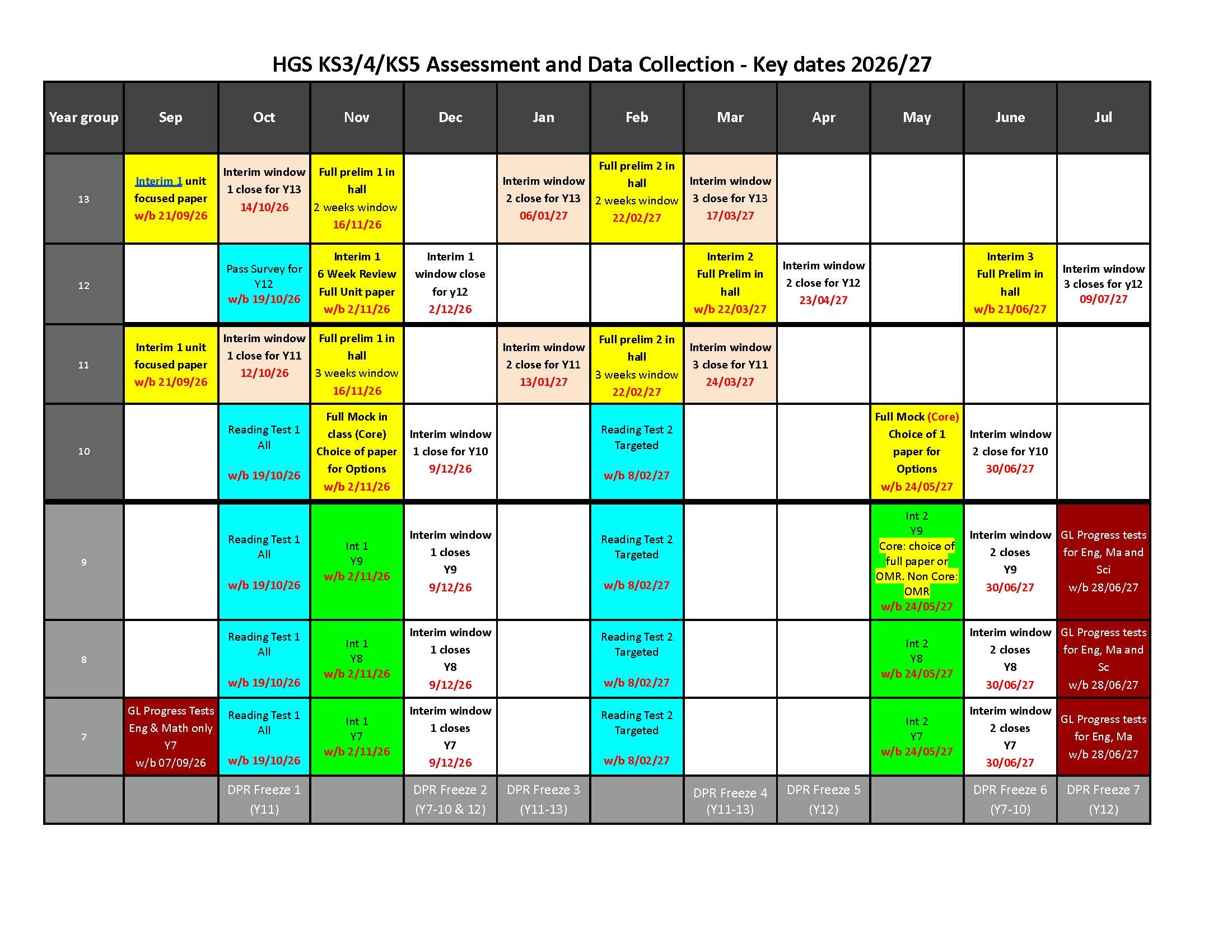
-
Our curriculum sets out a clear, differentiated learning journey for students with different starting points at KS2. For each subject and for each year group, we have carefully identified key learning objectives, which are carefully linked and sequenced to both KS3, KS4 and KS5 programmes of study.
-
Students are expected to demonstrate a ‘secured’ understanding in these key learning objectives within the course of a year
-
Teachers are encouraged to assess students’ learning every lesson through the deployment of various forms of AfL strategies. We also expect our teachers to ‘live mark’ students’ work during lessons. Teachers routinely use the CST Teaching and Learning Framework (Explicit Direct Instruction) to assess understanding through strategies such as memory retrieval, Turn and Talk, Mini Whiteboards, explicit vocabulary instruction, live marking and Show Call.
-
As part of our CST teaching and learning framework, teachers are encouraged to use the DPR when appropriate, as a live tool for assessment for learning during lessons (during independent work or plenary or whenever they check for understanding throughout the lesson).
-
From September 2026, students in Years 7–10 complete two formal interim assessments each academic year. Students in Years 11–13 complete three formal interim assessments to support public examination preparation and post-16 study. For Years 10 and11, we expect students to demonstrate their understanding of complex composite knowledge as reflected in GCSE style questions. For Years 12 and 13 students will demonstrate understanding directly linked either to A level specifications or to the BTEC externally examined units and learning aims.
-
Students and parents receive real time assessment judgements on the extent of student learning through DPR. These judgments tend to change regularly and therefore we encourage parents to login to DPR frequently and have conversations with their child about their progress. During parents’ evening, we provide the child’s DPR in printed form, which reflects the progress made by students at that specific time. Teachers may also use DPR Collaborations to provide personalised feedback and targeted next steps, enabling students to revisit misconceptions and secure key objectives.
-
For all students, we record and report a judgement on the key learning objectives which we colour code to mean the following:

8. The table below shows what we record and report:
| What we collect | What they mean | How we show progress | For which year group? |
|---|---|---|---|
| Percentages |
The percentage shown reflects the teacher’s professional judgement of how much of the expected curriculum the student has learned and demonstrated in their summative assessments for this term. It indicates how securely the student is meeting the learning expectations for the topics covered during the term. |
Percentages from 0% to 100% | Years 7, 8, 9 |
| Grades |
Current Grade: This is the grade your child has achieved from a recent test Predicted Grade: This is our best estimate, using the professional judgement of the teacher, of what your child will achieve at the end of KS4 course. It is based on how well they are progressing at the moment. |
We subdivide grades thus for GCSE: 7+: highly secure 7=: secure 7-: insecure A level: B+: highly secure B: secure B-: insecure |
Years 10 and 11
Years 12 and 13 |
9. If a child makes the expected progress between Year 7 and Year 11, it will look something like this:
| Students’ starting points at KS2, upon entry to Haggerston | Allocated pathway(s) for the student | Expected Year 11 GCSE grades linked to the pathway(s) |
|---|---|---|
| KS2 Level significantly above the expected level (Average Scaled Score 112 -120) | X | 8 or better |
| KS2 Level above the expected level (Average Scaled Score 106-111) | A | 7 or better |
| KS2 Level the same as the expected level (Average Scaled Score 99-105) | B | 6 or better |
| KS2 Level below the expected level (Average Scaled Score 90-98) | C | 4 or better |
| KS2 Level significantly below the expected level (Average Scaled Score <90) | D | Grades 1-3 |
10. At Key Stage 5,challenging targets are set based on a student’s Key Stage 4 outcomes using ALPS. Students who meet their ALPS attainment targets at the end of Key Stage 5 would be achieving above or in line with national averages.
2.4. How we provide careers information, advice and guidance to our students
-
Our Careers and Aspirations Manager runs a drop-in session as well as face-to-face interviews for all students about their career needs.
-
All of our KS4 and KS5 students receive a face-to-face impartial careers information and guidance interview with an external Careers Advisor from Future Smart Careers (at the end of Year 10, in Year 12 and again in Year 13.
-
We organise a week’s work experience for our Year 10 and Year 12 students. Students take part in a Careers Fair organised by our Careers and Aspirations Manager ..
-
The Careers Hub works closely with employers, higher education providers and training organisations to promote meaningful encounters with the world of work through visits, speakers, workshops and enrichment opportunities.
-
We have a clear programme of studies to support our students to successfully attend our sixth form and gain access to Russell Group Universities and high quality apprenticeships when they leave year 13.
-
We work closely with parents, employers, higher education providers and training organisations to ensure students are well informed about their future education, training and career pathways.