

DPR
What is DPR?
DPR serves as a comprehensive tool for monitoring and enhancing your child's academic journey.
Key Features
DPR empowers schools to report on your child's progress, assign homework, generate detailed reports, and facilitate effective feedback.
Key Learning Objectives
Each subject your child studies is structured around a set of key learning objectives. These objectives act as a roadmap for the academic year, outlining what your child is expected to learn. Periodically, your child receives a judgement for each key learning objective, indicating their level of understanding. For example, in the example below, the student has "secured" the key objective by the third data collection point.
Grades
Your school can also use DPR to report on figures such as current grade, attitude to learning etc. These are also collected on a termly basis.
Homework
Using DPR, teachers can seamlessly assign and track homework for your child. DPR provides a centralised platform for managing upcoming and completed assignments. As a parent, you can access this information through the DPR for Parents app.
More detail on how we assess and report what students learn
We have taken guidance from the ‘Final report of the Commission on Assessment without Levels’. We appreciate that ‘different forms of assessment may serve different purposes for different people and organisation’ and therefore adopted the following three broad overarching forms of assessment approaches:
| Formative assessments in every lesson |
These will be done in the following ways for all year groups: AfL techniques: Teachers deploy various AfL techniques to assess students' understanding of what has been taught. This includes question and answer and formative verbal and written feedback, including ‘live marking’ DPR as a real-time assessment tool: this will facilitate learning collaboration between students, teachers and parents about the extent of students learning against what has been taught. Low-stake quizzes: Regular re-cap quizzes to help students recall previously taught key objectives and memory contents. This is done primarily during lesson starters. Homework: Students will be expected to do homework in order to rehearse core knowledge. |
|---|---|
| Summative assessments - three times a year |
These will be done in the following ways for the following year groups: (Years 7-9) assessing the expanding domain: We will formally assess our students three times a year to help us understand how much learning they are able to successfully recall. (Years 10-11): all interim assessments are directly linked to GCSE specifications. The results from these tests can be used to further inform the DPR judgements. |
| Nationally standardised summative assessments |
The results from these tests can be used to further inform the DPR judgements. These include:
|
Our curriculum sets out a clear, differentiated learning journey for students with different starting points at KS2:
- For each subject and for each year group, we have carefully identified key learning objectives, which are carefully linked and sequenced to both KS3, 4 and 5 programmes of study.
Students are expected to demonstrate a ‘secured’ understanding in these key learning objectives within the course of a year.
Teachers are encouraged to assess students’ learning every lesson through the deployment of various forms of AfL strategies:
- We also expect our teachers to ‘live mark’ students’ work during lessons.
Teachers can also use DPR when appropriate:
- as a live tool for assessment for learning during lessons via plenaries
- or whenever they check for understanding throughout the lesson.
We assess students summatively three times a year:
- For Years 7-9, the tests are designed by subject leaders to assess the taught key objectives on an expanding domain basis.
- For Years 10-13, we expect students to demonstrate their understanding of complex composite knowledge as reflected in GCSE style questions.
Students and parents receive real-time assessment judgements on the extent of student learning through DPR
- These judgments tend to change regularly and therefore we encourage parents to login to DPR frequently and have conversations with their child about their progress.
- During parents’ evening, we provide the child’s DPR in printed form, which reflects the progress made by students at that specific time.
For all students, we record and report a judgement on the key learning objectives which we colour code to mean the following:
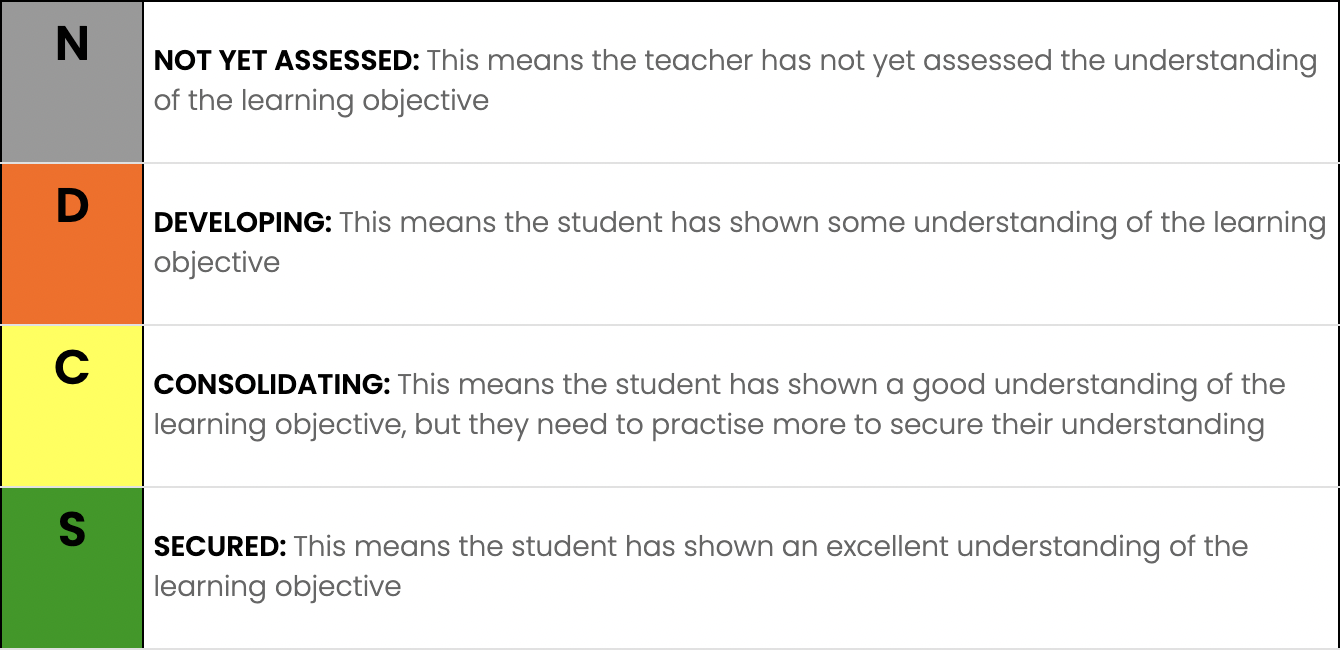
The table below shows what we record and report:
| What we collect | What they mean | How we show progress | For which year group? |
|---|---|---|---|
| ATL | Attitude Towards Learning. | 1 = Outstanding 2 = Good RI = Requires improvement N/A =Not Applicable |
All |
| Self Regulation | The extent to which students organise themselves without intervention from teachers or adults. | 1 = Outstanding 2 = Good RI = Requires improvement N/A =Not Applicable |
All |
| On/Off Track | The professional judgement made by teachers indicating if the student is on/off track against what they are expected to learn. | Y =Yes N =No |
Years 7, 8 and 9 |
| Grades |
Current Grade: This is the grade your child has achieved from a recent test Projected Grade: This is our best estimate, using the professional judgment of the teacher, of what your child will achieve at the end of KS4 course. It is based on how well they are progressing at the moment. |
We subdivide grades thus: 7a : highly secure 7b : secure 7c : insecure |
Years 10 and 11 |
If a child makes the expected progress between Year 7 and Year 11, it will look something like this:
| Students’ starting points at KS2, upon entry to HGS | Allocated pathway(s) for the student | Expected Year 11 GCSE grades |
|---|---|---|
| Progress significantly above the expected level of attainment at KS2 | X | 9 |
| A | 7, 8, 9 | |
| Progress the same as the expected level of attainment at KS2 | B | 5, 6 |
| Progress below the expected level of attainment at KS2 | C | 3, 4 |
| Progress significantly below the expected level of attainment at KS2 | D | 1, 2 |
| S | Up to 1 |
Pathways Explained
Pathway Model
Our pathway system is based on Key stage 2 data to provide aspirational targets for students. Our pathway system is reviewed annually so that students who consistently outperform their pathway targets can be moved up. Students are never moved down pathways. Students without KS2 data are assessed using CAT scores and baseline assessments.
| KS2 Level/Average | |||
|---|---|---|---|
| Pathway | English | Maths | Other Subjects |
| Pathway X | 112-120 | 112-120 | 112-120 |
| Pathway A | 106-111 | 106-111 | 106-111 |
| Pathway B | 99-105 | 99-105 | 99-105 |
| Pathway C | 90-98 | 90-98 | 90-98 |
| Pathway D | 80-89 | 80-89 | 80-89 |
Groupings – Key Stage 3
Using the pathways table above, the students will be in classes according to their pathways in English, Maths and Science. In other subjects, the students will be in mixed ability classes.
Groupings – Key Stage 4
Students are set on ability across the baccalaureate subjects and in mixed ability option groups for other subjects.